
Richard Strauss
Till Eulenspiegel – Don Juan
Audio
About this recording
MY RELATIONSHIP with RICHARD STRAUSS is a very close one. As the son of parents who were always making music, I grew up with Mozart, Haydn and Bach throughout my childhood and youth. There were also the televised “New Year’s Concerts” with Johann Strauss I and II and Josef Strauss, then—very early on—the Bruckner symphonies (Eugen Jochum’s records), and one of my absolute favourites: Johannes Brahms.
My introduction to Richard Strauss came later, only around the age of 16, through “An Alpine Symphony”.
My mother was an especially ardent Richard Strauss fan. She often sang and played, accompanying herself on the grand piano, soprano arias or passages from Strauss operas for long stretches, especially “Arabella”, “Capriccio”, also “Salome” and “Der Rosenkavalier”. She says that Haydn and Richard Strauss “sit very well in the voice”, Mozart less so, and Bach not at all. As a pianist, organ improviser and violinist, I never cared about this at all. On the contrary, I almost always found voices “out of tune”, “too loud”, even tiresome. Above all, “clattering” sopranos with “third-wide vibrato” were and remain a horror to me. My mother had a very slender voice, which is why I could “bear” it back then.
My approach to Richard Strauss is symphonic, just as it is to Wagner. I “put up with” voices. Strauss’s tone poems therefore suit me particularly well, especially as they allow me to let myself go completely at the piano.
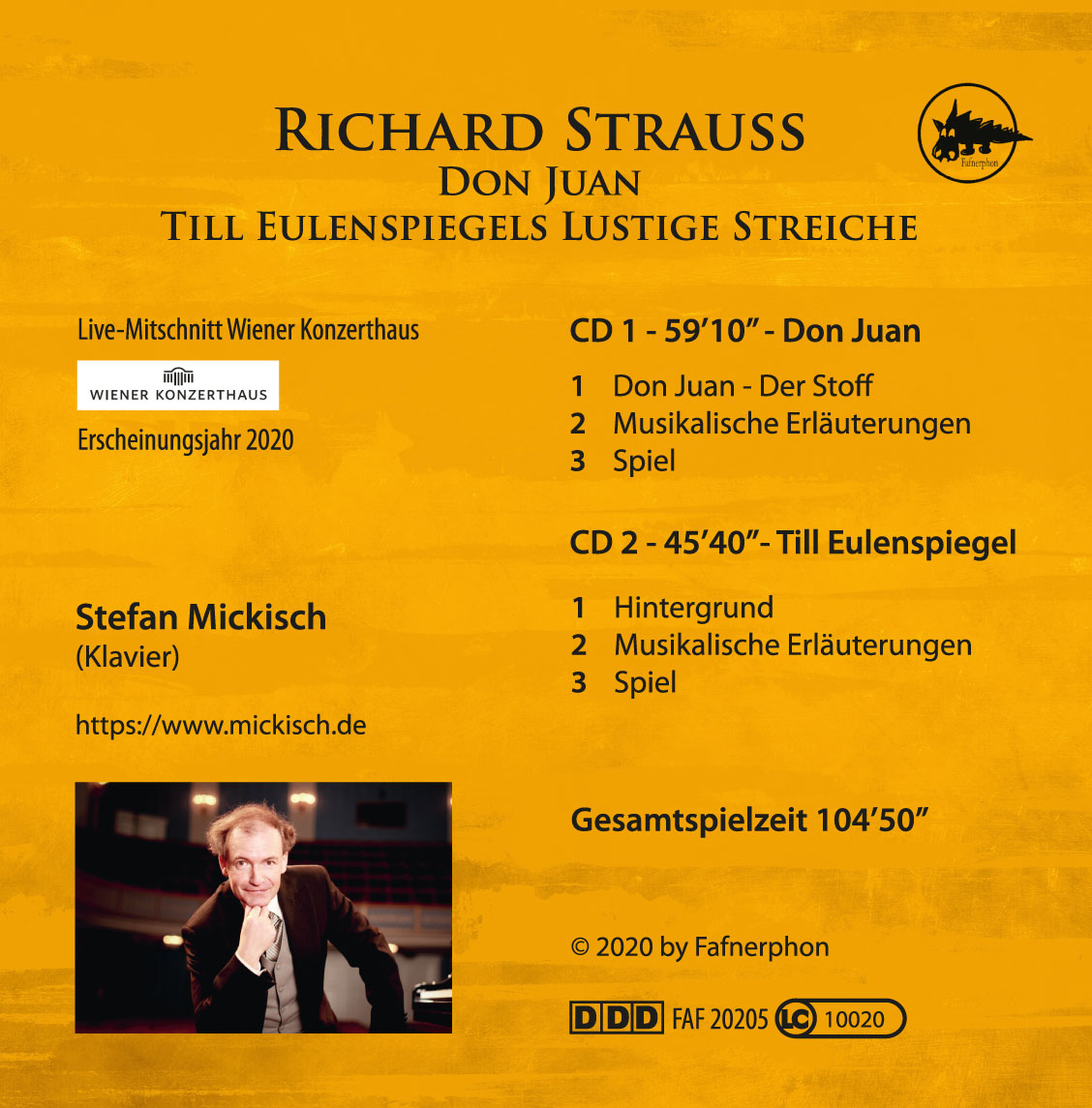
Live recording at the Wiener Konzerthaus.
- Don Juan
- Don Juan – the subject matter
- Musical explanations
- Performance
- Till Eulenspiegel
- Background
- Musical explanations
- Performance
Total playing time: 104′50″.
MY RELATIONSHIP with RICHARD STRAUSS is a very close one. As the son of parents who were always making music, I grew up with Mozart, Haydn and Bach throughout my childhood and youth. There were also the televised “New Year’s Concerts” with Johann Strauss I and II and Josef Strauss, then—very early on—the Bruckner symphonies (Eugen Jochum’s records), and one of my absolute favourites: Johannes Brahms.
My introduction to Richard Strauss came later, only around the age of 16, through “An Alpine Symphony”.
My mother was an especially ardent Richard Strauss fan. She often sang and played, accompanying herself on the grand piano, soprano arias or passages from Strauss operas for long stretches, especially “Arabella”, “Capriccio”, also “Salome” and “Der Rosenkavalier”. She says that Haydn and Richard Strauss “sit very well in the voice”, Mozart less so, and Bach not at all. As a pianist, organ improviser and violinist, I never cared about this at all. On the contrary, I almost always found voices “out of tune”, “too loud”, even tiresome. Above all, “clattering” sopranos with “third-wide vibrato” were and remain a horror to me. My mother had a very slender voice, which is why I could “bear” it back then.
My approach to Richard Strauss is symphonic, just as it is to Wagner. I “put up with” voices. Strauss’s tone poems therefore suit me particularly well, especially as they allow me to let myself go completely at the piano.
Live recording at the Wiener Konzerthaus.
CD 1 – 59′10″ – Don Juan
1 Don Juan – the subject matter
2 Musical explanations
3 Performance
CD 2 – 45′40″ – Till Eulenspiegel
1 Background
2 Musical explanations
3 Performance
Total playing time: 104′50″.