Richard Strauss
Thus Spoke Zarathustra – lecture-recital
Audio
About this recording
Friedrich Nietzsche’s (1844–1900) “Thus Spoke Zarathustra” is one of the most important and difficult books in human history.
I read the work’s four volumes from 1978 to 2014 before I fully understood it. For the first 15–20 years I rejected it, regarded it as a book for “dictators”, and was shocked by Nietzsche’s ruthless overturning of all “values” and his “megalomaniacal” choice of words. But after about 30 years it became increasingly clear to me that he was right in what he said—quite apart from the fact that, purely as an artist of language, he could easily stand comparison with Goethe, Schopenhauer and, later, Zweig, Freud and Thomas Mann. Failing to read and therefore know Nietzsche’s works, even simply as works of German literary art, characterises almost 100 per cent of Germans today and commands no respect.
Richard Strauss (1864–1949), unlike people in 2020, possessed a universal education. He read Goethe’s complete works no fewer than three times. Such people’s libraries were always little “Alexandrias”.
Owing to overwork and health problems in the 1890s, Strauss travelled to Greece and Egypt for several months. Incidentally, it was still possible then to travel around the world without a passport, without the “constitutional state” and the EU. Only very recently has this way of travelling reappeared (migration)…
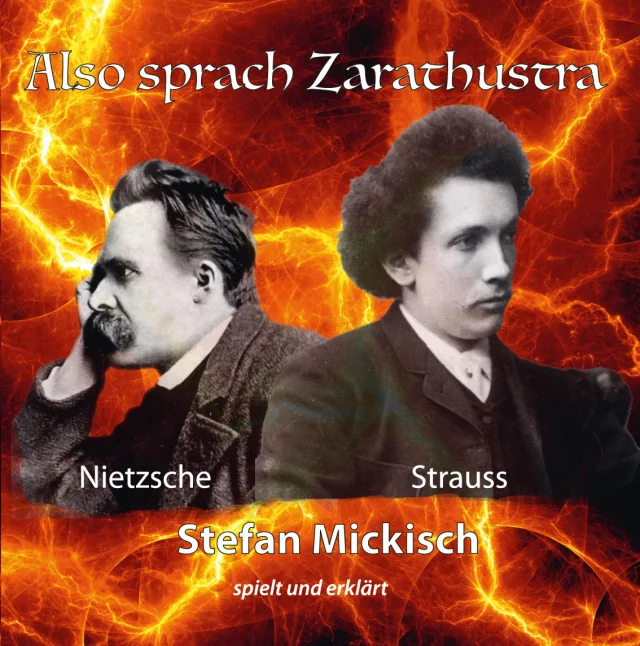
Nietzsche’s modernity fell on fertile ground with the free-thinking composer Strauss, and so this Munich native of Upper Palatinate heritage turned the “fifth Gospel” into music. The piece can only convince in the concert hall if conductors have read Nietzsche. Since this is not the case, I have realised it myself.
- Friedrich Nietzsche and Richard Strauss
- Strauss’s programme outline
- Explanations from the “Sun” to the “Waltz”
- Performance from the “Sun” to the “Waltz”
- Explanations through to the finale
- Performance through to the finale
Total playing time: 126′28″.
Friedrich Nietzsche’s (1844–1900) “Thus Spoke Zarathustra” is one of the most important and difficult books in human history.
I read the work’s four volumes from 1978 to 2014 before I fully understood it. For the first 15–20 years I rejected it, regarded it as a book for “dictators”, and was shocked by Nietzsche’s ruthless overturning of all “values” and his “megalomaniacal” choice of words. But after about 30 years it became increasingly clear to me that he was right in what he said—quite apart from the fact that, purely as an artist of language, he could easily stand comparison with Goethe, Schopenhauer and, later, Zweig, Freud and Thomas Mann. Failing to read and therefore know Nietzsche’s works, even simply as works of German literary art, characterises almost 100 per cent of Germans today and commands no respect.
Richard Strauss (1864–1949), unlike people in 2020, possessed a universal education. He read Goethe’s complete works no fewer than three times. Such people’s libraries were always little “Alexandrias”.
Owing to overwork and health problems in the 1890s, Strauss travelled to Greece and Egypt for several months. Incidentally, it was still possible then to travel around the world without a passport, without the “constitutional state” and the EU. Only very recently has this way of travelling reappeared (migration)…
Nietzsche’s modernity fell on fertile ground with the free-thinking composer Strauss, and so this Munich native of Upper Palatinate heritage turned the “fifth Gospel” into music. The piece can only convince in the concert hall if conductors have read Nietzsche. Since this is not the case, I have realised it myself.
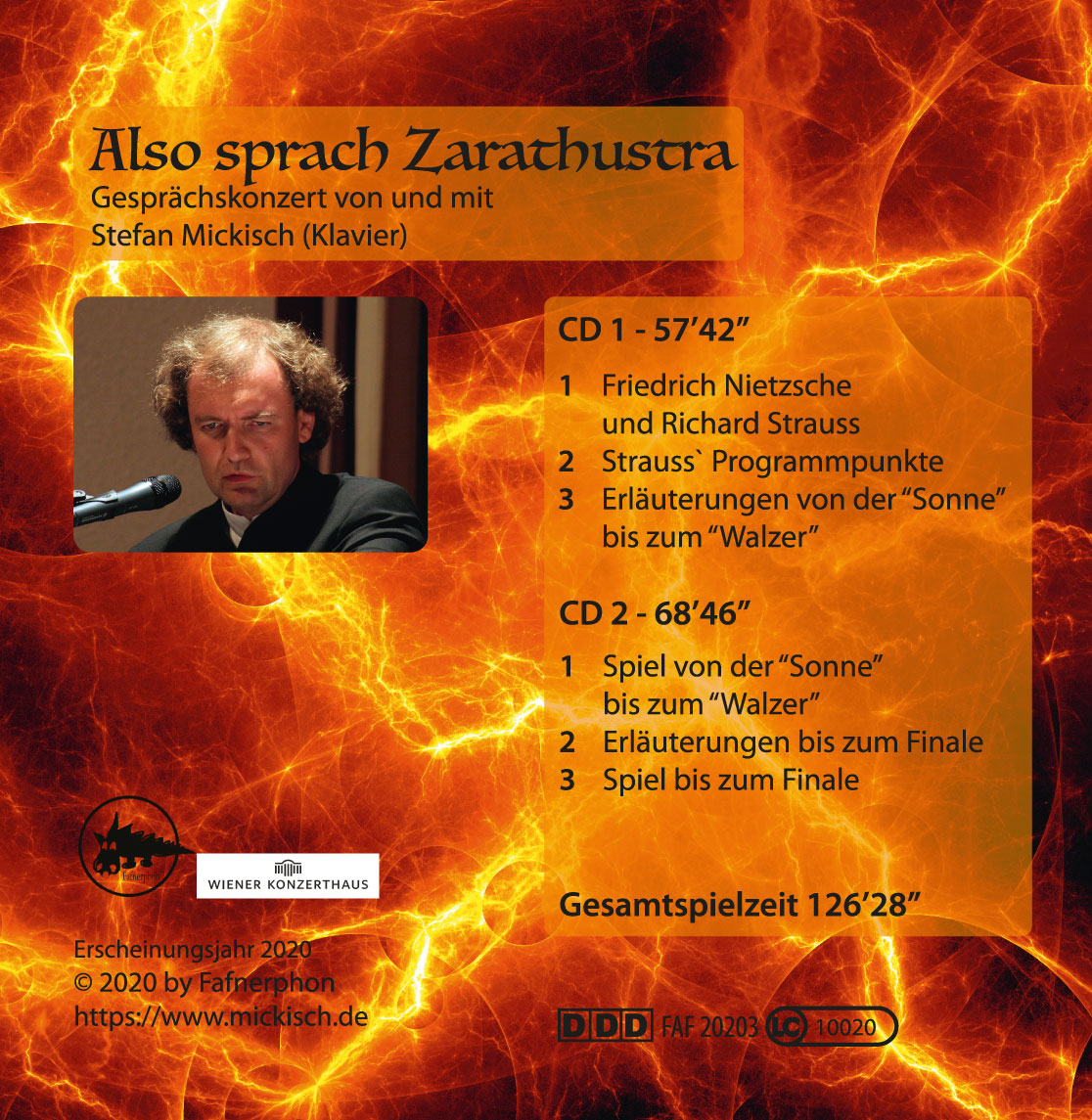
CD 1 – 57′42″
1 Friedrich Nietzsche and Richard Strauss
2 Strauss’s programme outline
3 Explanations from the “Sun” to the “Waltz”
CD 2 – 68′46″
1 Performance from the “Sun” to the “Waltz”
2 Explanations through to the finale
3 Performance through to the finale
Total playing time: 126′28″.